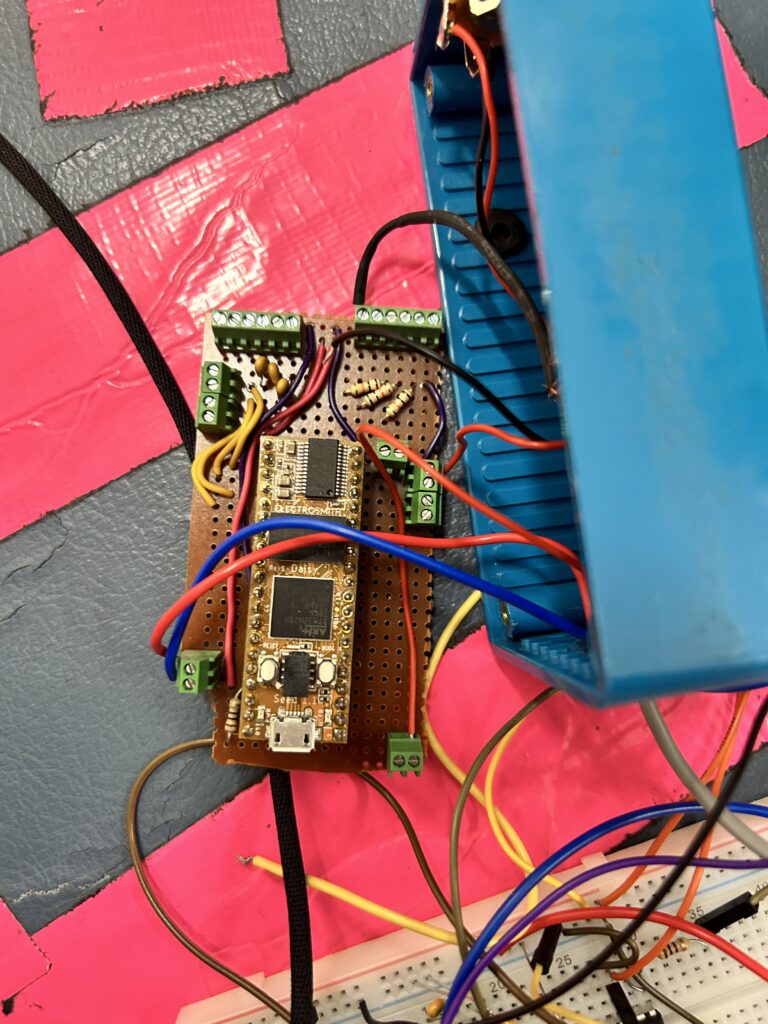
The sampler tentacle has been really fantastic instrument for live performance as it gives me a glitch sound that works well with my samples and other instruments.
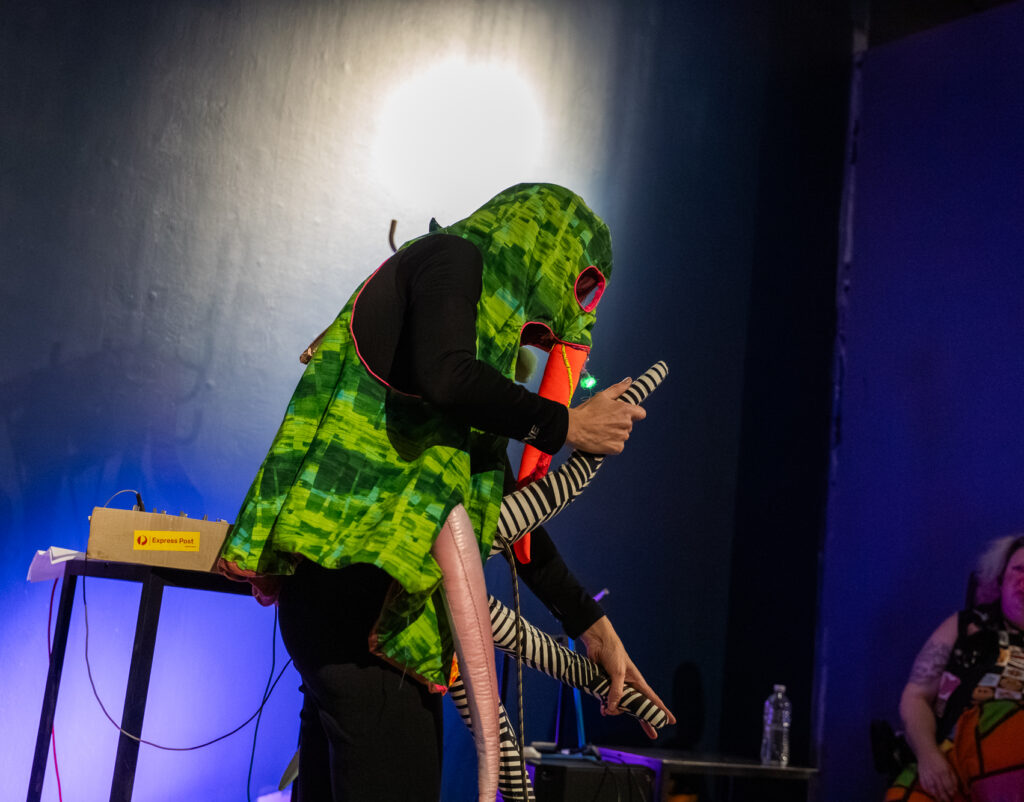
The sampler tentacle is a hooded costume with two tentacles that control sound parameters and one tentacle with a soft switch to record audio. The central tentacle can be squeezed to control recording. The costume features a green LED that turns red while recording is in progress. The recorded audio plays back in a continual loop. One tentacle controlled the length of the audio loop that is played back, the other tentacle controlled the pitch of the playback. This first iteration had an audio Jack wired up to accept an external microphone or other instrument. While the flexibility of being able to change the audio source was useful, it complicated the instrument making it difficult to manage in a live performance moment. It requires coordination and communication between two people and how to do it was difficult to communicate during a live performance.
The second iteration of this instrument embedded an electric microphone into the costume near the wearer’s mouth. This simplified the interaction. A small speaker was also attached to the costume for monitor playback to better hear oneself in a live situation. I have performed with this second iteration of the costume at NIME 2025 in Kamberri/Canberra, Cyber Bunker & KEPK in Magandjin/Brisbane and ACE in Tarndanya/Adelaide.
The tentacle instrument has degraded over time. There were two reasons for this one was an issue in the electronics and the second one was a wear and tear issue. one challenge in moving to digital circuits with body contact has been that width of parameters felt narrow. There was not a lot of difference between a soft touch and a hard touch and they began to become less reliable.
Grimy humans strike again
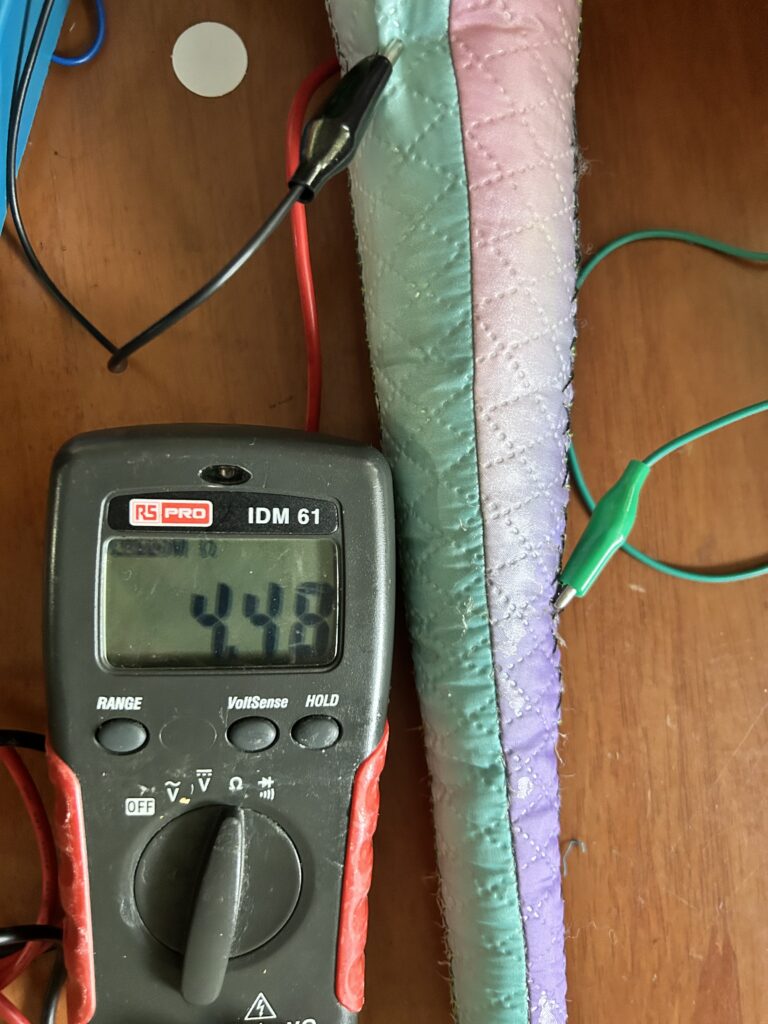
I used a shiny quilted fabric for these tentacles. I observed an issue that has also occurred in other shiny quilted fabrics which was that the fabric became conductive through use. Using a multimeter I observed conductivity between the two sides of the tentacle when there was no hand connecting them. This would mean the original voltage divider values no longer produced a usable ADC range.Washing the tentacles resolved the issue of conductivity across the base fabric. In this case the costume had only been used about five times and mostly by myself. in comparison to other costumes this was much quicker to have a grind buildup that caused issues.therefore I am replacing the tentacles with new tentacles built from different fabric and will seek out fabric that can be wiped down but is still light and durable. I am avoiding metallic and opalescent fabrics as the two instances this is occurred was both with quilted shiny fabric.
Correcting the voltage divide
When I initially began to use the tentacles with digital circuits, I applied the same logic as I had used to use light dependent resistor with Arduino and set up a voltage divider sending one side of the tentacle trace to the 3.3 V, And the other side to the input pin with a resistor going to ground. I had always used a 10k pulldown resistor for this and continued to do so. The original costume version use a 10 K pulldown resistor with no buffering between the voltage divider and the Daisy seed ADC. This meant that the readings were compressed into a very small range with the output from the body contact sensors ranging between zero and 120. This small range required a lot of maths in the code and did not produce a satisfying parameter width, the signal was susceptible to noise due to high impedance.

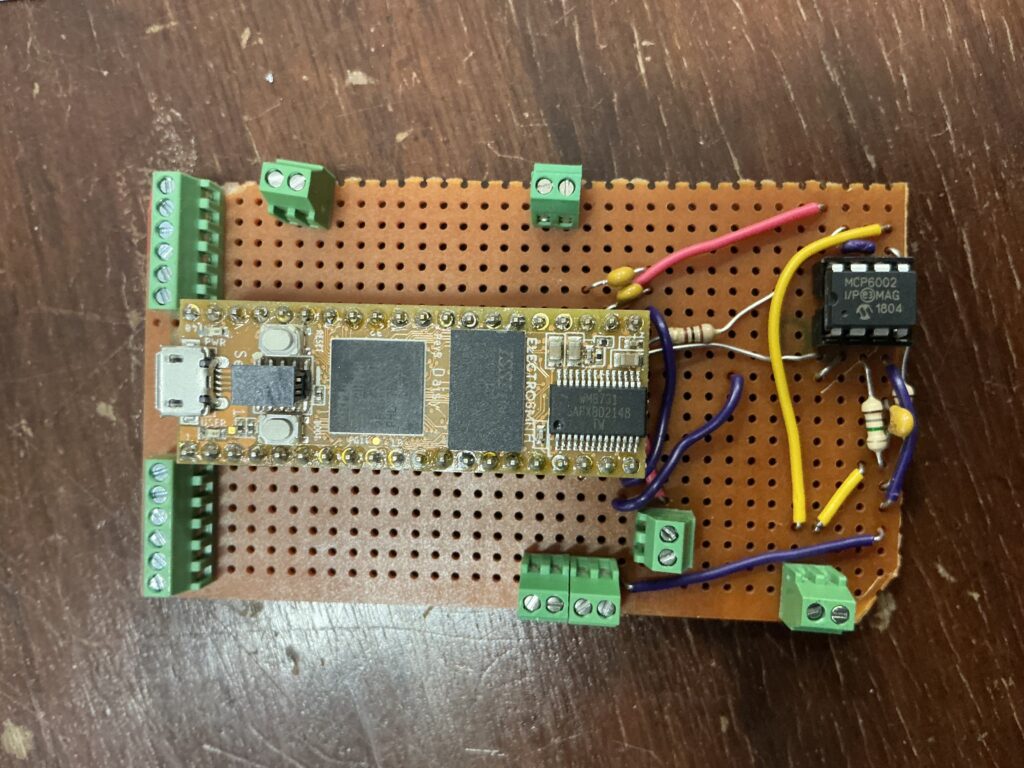
I used a multimeter to measure the resistance from the tentacle sensor, it ranged between 500kΩ with strong contact to 5MΩ with a light touch and no connection with no contact. These values are too high impedance to work with a 10kΩ resistor in the voltage divider and the signal was being swamped. I calculated that a 1.8mΩ resistor would give a good voltage swing. However, even with this updated voltage range the high impedance would distort the readings in the Daisy. To counteract this I added an MCP6002 op amp as a buffer to the input. The MCP6002 is a dual op amp which allows me to buffer each tentacle with one chip. I tested these inputs with an Oscillator and was able to get a good variation in the parameter depth. More work is still to be done on the response of the curve.